China’s permanent residency landscape is quietly shifting gears in 2026. The PhD pathway—once the easiest ticket to Chinese Permanent Residence—has become a much tougher arena with higher bars, stricter reviews, and stronger filtering. How did the policy evolve over the past decade? How are cities diverging today? And where is this heading in the next three years? Here’s what you need to know.
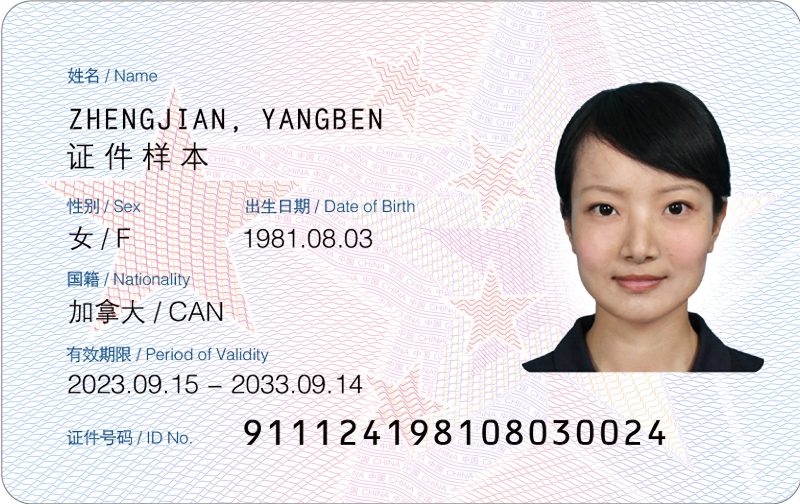
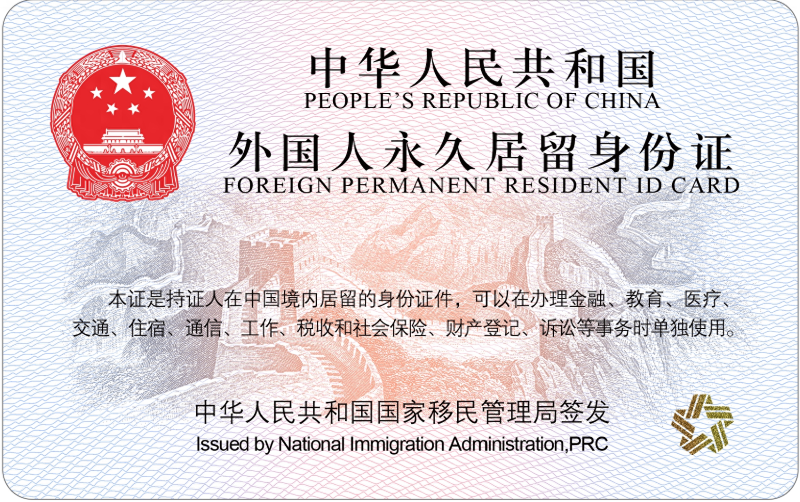
The “Five-Star Card” is the popular name for China’s new Foreign Permanent Resident ID Card. It earned the nickname from the five-star design element on the card face. Issued by the National Immigration Administration, it allows holders to reside in China indefinitely without renewing their visa every year. In daily life—boarding high-speed trains, checking into hotels, opening bank accounts, using Alipay and WeChat—it works just like a Chinese citizen’s ID card.
How the PhD Pathway Began
The idea that a PhD holder could apply directly for Chinese permanent residency didn’t exist from the start. It traces back to 2016.
In March 2016, Beijing’s Zhongguancun—designated as a national-level talent special zone—pioneered a pilot policy: former Chinese nationals with a doctoral degree or above, or those who had worked continuously at a Zhongguancun
company for four years, could apply directly for permanent residency in China. This was the prototype of the PhD permanent residency pathway.
August 1, 2019 marked a pivotal turning point. The National Immigration Administration reviewed and refined a batch of pilot policies from free trade zones and demonstration zones, then rolled out 12 immigration convenience measures nationwide. The core provision read:
“PhD + a Job in China = Permanent Residence”
“Former Chinese nationals holding a doctoral degree and working in China may apply for permanent residency through the exit-entry administration of the public security bureau. Their foreign spouses and minor children may apply simultaneously. This policy applies nationwide with no regional restrictions.”
The key takeaways: nationwide implementation, no regional limits, and a PhD plus a job was all you needed. At the time, this was considered a remarkably open and convenient measure. There were no mandatory work-duration requirements, no income thresholds, and no elite-university prerequisites—if you had a doctorate and a job in China, you essentially qualified.
Another milestone came in late 2023. On December 1, 2023, the new-version Five-Star Card officially launched. The card number expanded from 15 to 18 digits, matching the format of a Chinese citizen’s ID card. It became seamlessly usable across transportation, hotel check-ins, financial services, mobile communications, tax payments, and internet platforms. This upgrade transformed the permanent resident card from a mere “proof of identity” into a genuine “life access pass.”
2026: The Wind Changes Direction
In early 2026, news that sent shockwaves through the foreign PhD community broke: Shanghai’s PhD permanent residency policy page suddenly vanished. Rumors of “Shanghai cancels PhD
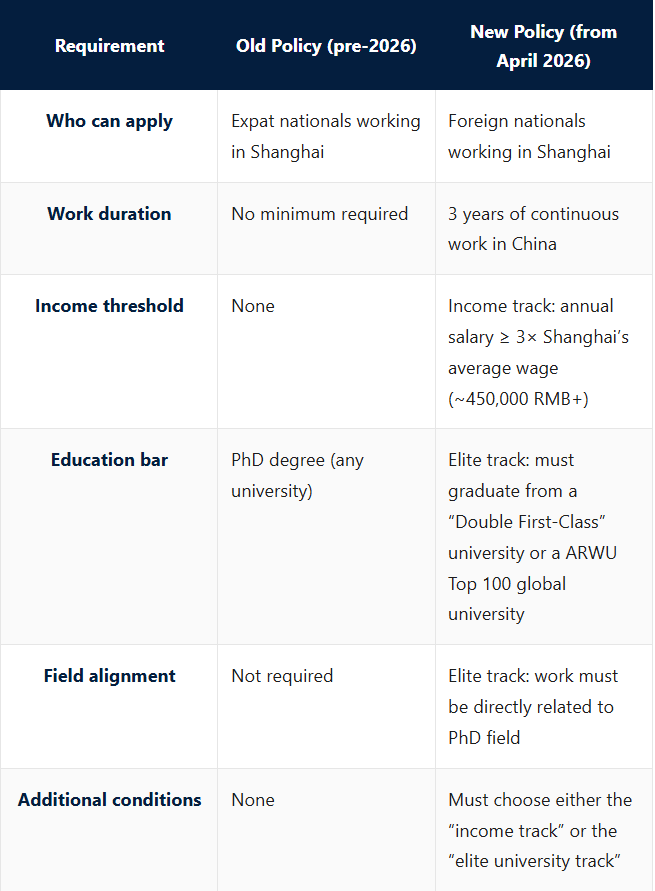
permanent residency” spread like wildfire. In reality, it wasn’t a cancellation but an adjustment. On April 2, 2026, Shanghai re-released its PhD
permanent residency policy—with noticeably higher bars.
Old vs. New: How Shanghai’s PhD Requirements Changed
Suzhou followed suit.
After Shanghai released its new policy, Suzhou aligned its standards with Shanghai’s. In other words, the core cities of the Yangtze River Delta are converging on a unified, stricter set of PhD permanent residency review standards.
City by City: Rules Differ
Unlike the tightening trend in Shanghai
and Suzhou, several cities still maintain open and flexible PhD permanent residency pathways. Smaller cities are even doubling down on talent attraction policies.
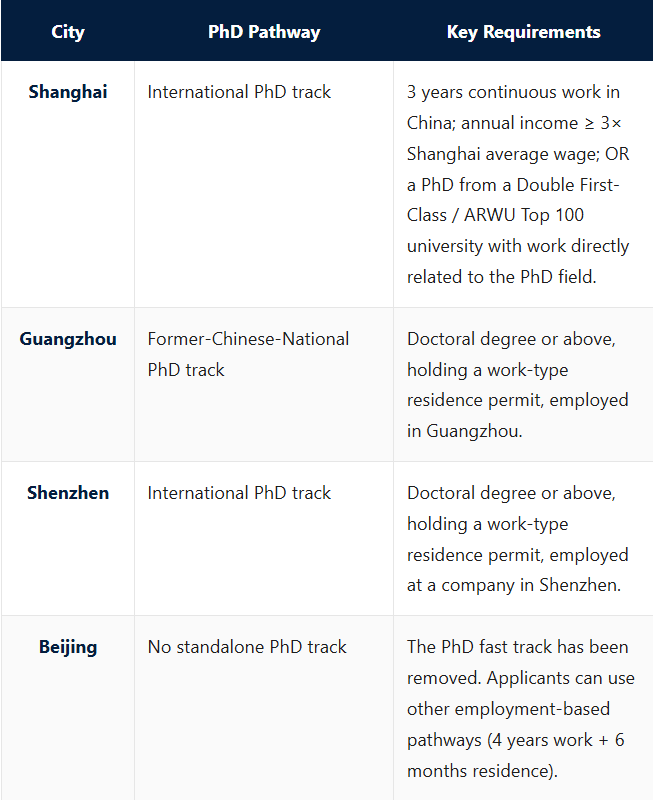
●Shenzhen: Still one of the more lenient cities. According to the Shenzhen Public Security Bureau’s official guidelines, international PhD holders with a work-type residence permit employed at a Shenzhen company can apply for permanent residency.
●Guangzhou: The former-Chinese-national PhD pathway remains in place. Requirements: a doctoral degree or above plus a work-type residence permit and employment in Guangzhou. No income or elite-university conditions listed.
●Lishui and other smaller cities: Per a public response from the Lishui municipal government, international nationals with a doctoral degree can apply for permanent residency. The city has already processed Chinese Permanent Residence for 10 PhD holders and their families. Smaller cities are still actively leveraging national talent policies to attract skilled professionals.
Based on our research, here’s how key cities compare:
Three Key Trends to Watch
Pulling it all together, three major trends emerge:
Trend 1: From “Degree Only” to “Degree + Contribution”
When the PhD pathway launched in 2019, it was essentially “degree-driven”—having a PhD was enough. By 2026, Shanghai and Suzhou have shifted to a dual-filter model: your degree plus either economic contribution (high income and tax revenue) or academic caliber (elite university + relevant work). Simply put: it’s no longer just about whether you have a doctorate, but whether your PhD “counts” and whether your work delivers real output.
Trend 2: One Standard → Regional Divergence
The 2019 policy was a unified framework: “nationwide, no regional restrictions.” But by 2025–2026, implementation standards are diverging fast.
Shanghai and Suzhou have raised their bars first. Shenzhen and Guangzhou are holding the line for now.
Smaller cities are still using the basic PhD pathway to attract talent. This divergence aligns with the national strategy of building high-level talent hubs in Beijing, Shanghai, and the Greater Bay Area—top-tier cities can afford to be selective, while smaller cities still need to cast a wide net.
Trend 3: Thresholds Rise — Not Cancelled, Upgraded
The Shanghai case is highly representative: the policy wasn’t cancelled, it was “upgraded.” In policy language, “upgrade” almost always means higher bars. In November 2025, the Ministry of Justice and the National Immigration Administration held a special symposium to solicit feedback on the “Regulations on the Administration of Permanent Residency of Foreign Nationals.” Participants recommended “further standardizing and improving” the review process—which, in plain English, means: stricter reviews and higher standards are coming.
Action Guide: Four Tips for PhD Applicants
If you’re planning to apply for the Chinese Permanent Residence through the PhD pathway, here’s what to keep in mind:
1. Apply as early as possible.
Policy thresholds are never set in stone. A pathway that was open last year may be half-closed this year. Don’t wait.
2. Plan for a 3-year horizon.
Even if your current city doesn’t yet require a minimum work duration, the Shanghai and Suzhou precedents suggest that 3 years of continuous work with an uninterrupted residence permit is becoming the new baseline. Changing jobs mid-way, gaps in tax records, or breaks in your residence permit can all become dealbreakers when you apply.
3. Get your academic credentials in order.
Foreign doctoral degrees must be authenticated by the Chinese Service Center for Scholarly Exchange (CSCSE) or through Hague Apostille / Legalization—this is a hard requirement. If you’re aiming for the elite-university track, verify in advance whether your institution is on the ARWU Top 100 or China’s Double First-Class list.
4. Authentic documents + stable income + continuous residence = your three anchors.
No matter how the policy shifts, these three principles remain the foundation of every review.
The Bottom Line
The PhD pathway to the Five-Star Card is evolving from a wide-open door into a selective one. For those with genuine academic credentials, stable income, and a long-term plan to stay in China, this is actually a fairer and more respectable era. For anyone still thinking “a degree alone is enough,” the sooner you read the trend and start planning, the more control you’ll have as the policy turns.
The PhD pathway to the Five-Star Card is evolving from a wide-open door into a selective one. For those with genuine academic credentials, stable income, and a long-term plan to stay in China, this is actually a fairer and more respectable era. For anyone still thinking “a degree alone is enough,” the sooner you read the trend and start planning, the more control you’ll have as the policy turns.